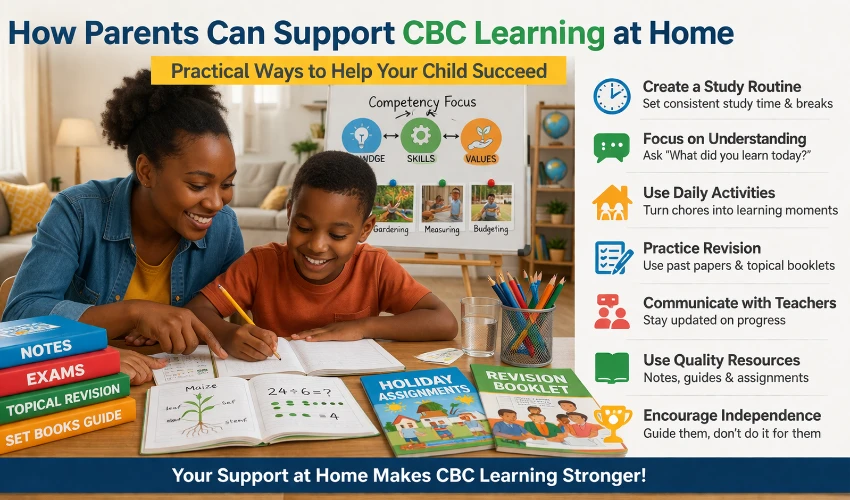
How Parents Can Support CBC Learning at Home
CBC has changed what learning looks like in Kenya. It no longer focuses only on passing Exams. It focuses on building skills, understanding, and real-life application. This shift affects your role as a parent more than you may realize.
You are no longer just checking homework and report cards. You are part of the learning process. If your child struggles or succeeds, your involvement plays a direct role.
The question is simple. Are you actively supporting learning at home, or are you leaving everything to the teacher?
Understand What Your Child Is Learning
You cannot support what you do not understand. Many parents still view education through the old system, where marks were everything.
CBC focuses on competencies. Your child is expected to develop skills like problem-solving, communication, and creativity.
Take time to understand:
- The subjects your child is studying
- The competencies they are expected to develop
- How assessment works
The Kenya Institute of Curriculum Development explains CBC structure and expectations:
https://kicd.ac.ke/cbc/
If your child is learning about agriculture, for example, they are not just memorizing crops. They should be able to identify, explain, and even apply that knowledge at home.
Have you asked your child to show you what they can do, not just what they scored?
Create a Simple Study Routine at Home
Children need structure. Without it, learning becomes irregular.
You do not need a complex timetable. A simple routine works:
- Set a consistent study time
- Allocate time for different subjects
- Include short breaks
This builds discipline and helps your child stay focused.
You can use Holiday Assignments or Notes from Mwalimu Plus to guide what your child studies during these sessions.
Ask yourself: Does your child have a clear study routine, or do they study only when exams are near?
Focus on Understanding, Not Just Marks
Marks still matter, but they are not the full picture under CBC.
Your child may score average marks but show strong understanding and skills. You need to look beyond grades.
Instead of asking:
“What did you score?â€
Ask:
“What did you learn today?â€
“Can you explain it to me?â€
“How would you use it in real life?â€
This approach helps your child think deeper and builds confidence.
If your child uses Topical Revision Booklets, focus on how they solve questions, not just whether the answers are correct.
Use Everyday Activities as Learning Opportunities
CBC encourages practical learning. You do not need a classroom to support this.
Daily activities can reinforce what your child learns:
- Cooking can teach measurements and hygiene
- Shopping can teach budgeting and arithmetic
- Gardening can support science and agriculture
These activities help your child connect school learning to real life.
If your child studies business or agriculture, involve them in simple home tasks. Ask questions and let them explain what they know.
Are you creating opportunities for your child to apply what they learn?
Support Revision the Right Way
Revision is not just about reading Notes. It involves practice and application.
Help your child:
- Use Exams to practice answering questions
- Focus on weak areas using Topical Revision Booklets
- Review mistakes and understand them
Mwalimu Plus provides structured resources that can guide this process.
Avoid pushing your child to read for long hours without direction. Focus on quality, not just time.
If your child studies for two hours, do you know what they actually did during that time?
Communicate With Teachers
Teachers see your child in a learning environment. You see your child at home. Both perspectives matter.
Regular communication helps you:
- Understand your child’s strengths and weaknesses
- Align home support with classroom expectations
- Address issues early
Do not wait for report cards. Ask specific questions:
- Where is my child struggling?
- How can I support at home?
- What resources should we use?
This creates a stronger support system for your child.
Provide the Right Learning Resources
Access to the right materials can make a big difference.
Instead of searching randomly, use structured resources like:
- Notes for content understanding
- Exams for practice
- Set Book Guides for literature
- Records of Work to track progress
Mwalimu Plus offers these in organized categories, making it easier for you to support your child.
You do not need many resources. You need the right ones.
Are you giving your child tools that match what they are learning in school?
Encourage Independence
CBC aims to develop self-driven learners. You should support your child without doing the work for them.
Guide them, but let them think and solve problems on their own.
For example:
- Ask questions instead of giving answers
- Let them attempt assignments before helping
- Encourage them to explain their reasoning
This builds confidence and critical thinking.
If you always step in, your child may depend on you instead of learning independently.
Monitor Progress Without Pressure
Tracking progress helps you understand how your child is doing. But too much pressure can create fear.
Use simple methods:
- Review completed work
- Check improvement over time
- Discuss challenges openly
Records of Work can help you track what your child has covered.
Focus on progress, not perfection.
Is your child improving, or are they afraid of making mistakes?
Build a Positive Learning Environment
Your home environment affects how your child learns.
A quiet, organized space can improve focus. Support and encouragement can boost motivation.
Avoid constant criticism. Recognize effort and improvement.
Learning is a process. Your role is to support it, not control it.
The Role You Play
CBC requires active involvement from parents. You are not expected to replace the teacher, but you are part of the system.
Your actions at home can strengthen or weaken what happens in school.
Think about your current approach:
- Do you understand what your child is learning?
- Do you support revision effectively?
- Do you create opportunities for practical learning?
Small changes in how you support your child can lead to better outcomes.